What "SOHO" means in Japanese rental listings
SOHO is a real search category in the Japanese rental market, but it is not a regulated term and it means at least three different things. How to read it, and what to ask.
Search Japanese rental sites and you will find a filter called SOHO. It stands for small office / home office — a phrase that arrived from English in the 1990s and then took on a life of its own here, to the point where the Japanese usage no longer maps cleanly back.
It matters because “SOHO” is often the exact category someone needs without knowing it exists — that goes for freelancers already living here as much as for people arriving from abroad. It also matters because the label is unregulated, so two listings both tagged SOHO can mean very different things.
What it usually means
In Japanese listings, SOHO可 (“SOHO OK”) typically signals: you may live here and also run a small, quiet business from it. The implied picture is one person, or two, with no staff and no stream of visitors. Not a company office with a reception desk.
That is the useful centre of the term. Around it, in real listings, it stretches in three directions:
1. Residential lease, work tolerated. The most common. A normal residential contract; the landlord is signalling they will not object to you working. Registration and signage are usually still separate conversations.
2. Residential lease with explicit business permission. The sheet says something concrete — office use permitted, company registration OK, sometimes both. This is the one worth hunting for if you are self-employed.
3. Actually a small commercial unit. Occasionally “SOHO” is used for a compact office space that is not licensed for residence at all. You cannot live in it. The rent will look attractive per square metre and the consumption tax and contract type will be different.
Those three are not interchangeable, and the tag alone does not tell you which one you are looking at. The conditions table does.
Why it isn’t the same as “office”
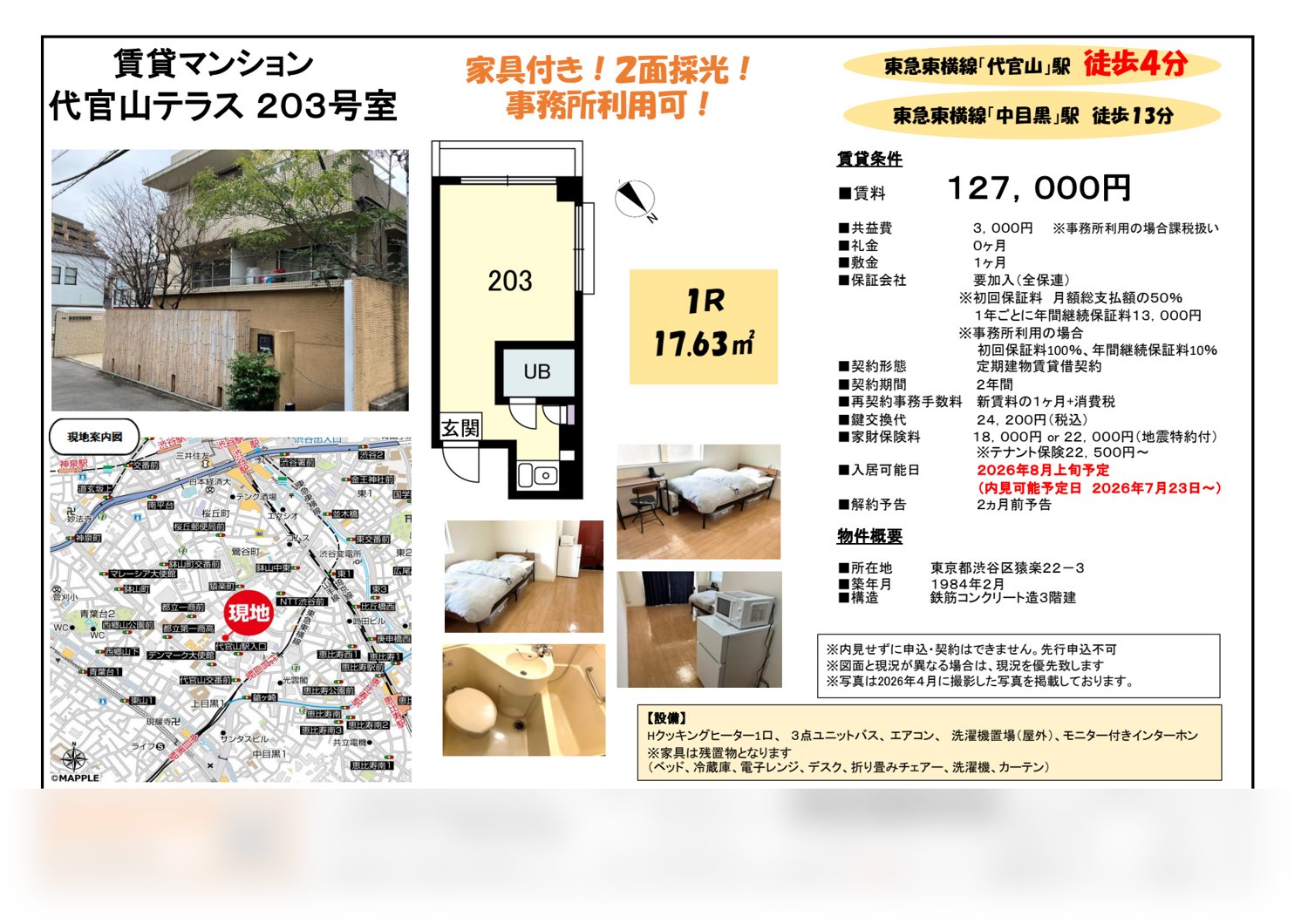
English speakers reasonably read SOHO as “office-ish.” In Japanese listing practice, 事務所 (office) and SOHO are treated as different things — and a single sheet can say office use: not permitted and SOHO use: permitted at the same time without contradicting itself.
The distinction is about what the building experiences. Office use means clients arriving, a nameplate, staff, a business address people come to. SOHO means someone lives there and happens to work. We wrote about that split in more detail in Can you work — or register a company — from a Japanese rental?.
What actually makes a room good for this
The label gets you into the shortlist. Whether the room works is a physical question, and it is not the one the listing filters answer.
Can you put work somewhere that is not the bed? A studio where the desk has to face the futon is fine for a month and corrosive for a year. What you want is separation — a second room, a maisonette or split level, an alcove, an L-shaped plan, a wall you can dedicate.
Is there a wall for a desk that is not a window and not a closet? Look at the floor plan, not the photos. Count the usable wall runs.
How does the light move? If you are home all day, a north-facing single-aspect flat is a different life from a two-aspect corner. Dual aspect (二面採光) is worth real money to someone who works at home and almost nothing to someone who is out from eight to eight.
Will a video call embarrass you? Ceiling height, what is behind you, whether the entrance opens straight into your frame.
Can the building take it? Delivery lockers, whether the entrance is auto-locked, and how the walls sound — you will find out fast if you are on calls.
Those are the criteria we actually select on. It is why our listings are few and each one carries a note explaining what it is for, rather than a checklist of amenities.
The vocabulary you will meet
| Japanese | Reading | What it means on a sheet |
|---|---|---|
| SOHO可 | SOHO ka | Living + small-scale work is acceptable |
| 事務所使用可 / 不可 | jimusho shiyō ka / fuka | Office use permitted / not permitted |
| 法人登記可 | hōjin tōki ka | You may register a company at this address |
| 事業用 | jigyō-yō | Business use — often means you cannot live there |
| 外国籍相談可 | gaikokuseki sōdan ka | Non-Japanese applicants considered |
| 定期借家 | teiki shakka | Fixed-term lease — ends on its date, renewal not automatic |
| 二面採光 | nimen saikō | Windows on two sides |
Two of these deserve a flag. 定期借家 is a genuinely different contract from an ordinary lease: it terminates at the end of its term and renewal is at the landlord’s discretion, so a two-year fixed term is a two-year plan, not a starting point. And 事業用 is the one that catches people — a cheap “SOHO” that turns out to be business-only is a unit you are not allowed to sleep in.
How to search for it
If you are looking on Japanese portals yourself, the productive search terms are SOHO 賃貸, SOHO可 マンション, and — if you need the address for a company — 法人登記可 賃貸. Filtering by 事務所可 alone will bury you in actual commercial space.
Or start from a shortlist where someone has already read the sheets. Every room here shows its office-use status as a field taken from the leasing document, and where the landlord accepts company registration or overseas screening we put that on the page too — because those are the lines that decide whether a room is possible for you, and they are exactly the lines most listings leave you to guess at.
This is a general explanation of how things work in practice, not legal or tax advice. Terms vary by property, landlord and guarantor company. Always check your own case with us.